
Clicker Expo Take aways
Clicker Expo Take aways
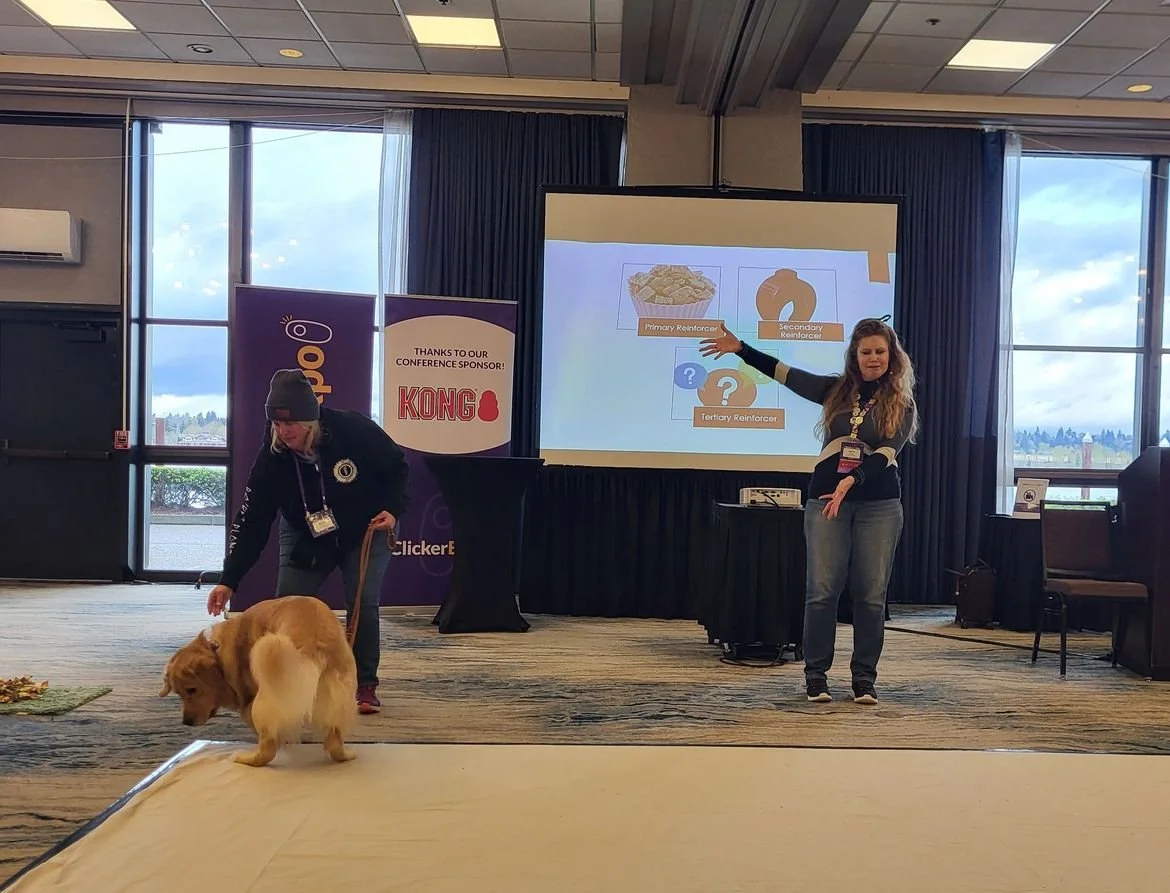
Dawn & Leo at Clicker Expo
We were called out to demonstrate the clean stimulus control loop as Leo was the only dog that waited before cues without offering a behavior.
Having been at this for a long time and staying current with a lot of continuing education I won’t say that I got a lot of new information, which I suppose is validating. But I do always come away with some nice reminders of things to focus on that are always helpful. So I am going to start by talking about stimulus control and structured training sessions and how they go hand in hand.
What does stimulus control mean?
Basically it means “sit” means sit no matter how, when or where you say it. The truth is few dogs are trained to the point of complete fluency and understanding even with the most basic foundational cues. Most dogs have problem solved the cues in context; come means come if you put your hand in your treat pouch first. down means down if they sit first, you bend over and point to the ground. But when you take these cues out of context they can no longer understand and complete them.
Ways you can test your dog’s fluency of “sit”
If you stand completely still and do not move your hands at all will they sit when you ask?
If you are sitting in a chair with your hands in your lap under the table will they sit when you ask?
If you are laying down on the floor will they sit if you don’t move your hands when you ask?
Will they sit when you ask if you are standing with your back to them?
Can they sit from a down position if you don’t move your hands?
Beyond the fluency of understanding the cue, stimulus control also means they don’t offer another behavior instead or in conjunction.
If you ask your dog to sit, do they wait until you cue what is next or do they then offer another behavior like a down, or pop back up before you release? If you have cued a behavior, stimulus control would indicate your dog does only that behavior.
Ways you can test these aspects of stimulus control
Repeat the same cue 3-4 times, so for example you toss a treat, the dog comes back, you cue a sit, they sit, you reward and toss another treat, they come back and you repeat that pattern.
After 3-4 reps, now when they return give a unknown cue (say a random word like “banana”) do they sit? This would indicate they are responding more to the pattern than your actual cue.
Do the same thing, only after your 3-4 reps cue a different known cue, for example the first 3 reps you cue a sit, then on they 4th you cue a down.
Write random down 10 numbers between 1-20 (you can use rolling dice to make it truly random)
Use this list as the length of pause between cues, for example, your list is: 1, 5, 13, 2…) you toss a treat, your dog returns you cue sit, count to 1 and then reward, release with a treat toss, when they return you cue sit, count to 5, then reward, release with treat toss when they return you cue sit, count to 13, reward….and so on. Do they offer other behaviors during those pauses?
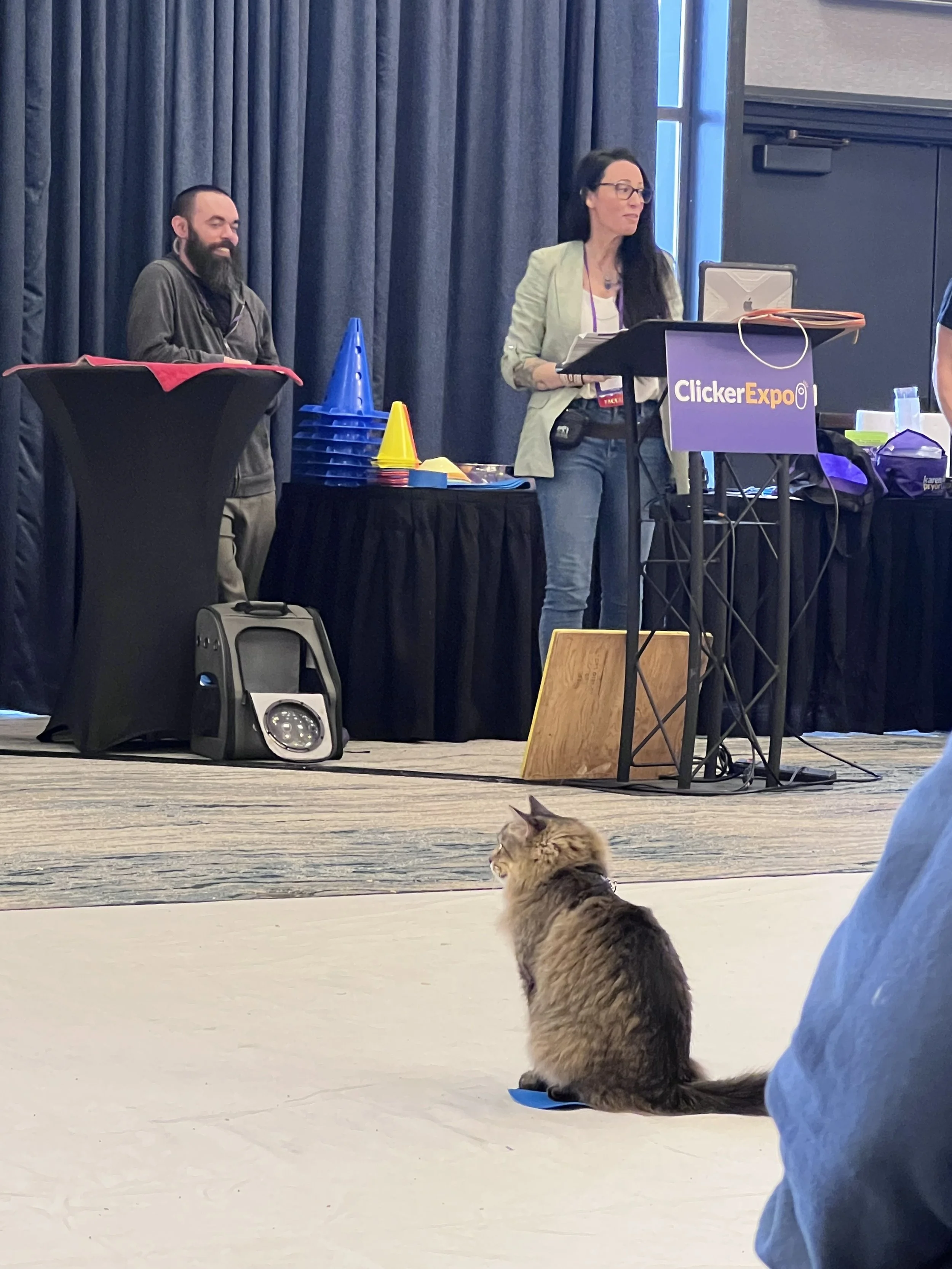
Tonic, the movie star cat demonstrating waiting on his mark. He sat there doing nothing else for over 5 minutes while Melissa Millett spoke and took questions. A lovely example of complete stimulus control for his “mark”. (The podium her helper is leaning on is his start station, his crate the pause station)
If you run these experiments and see weak spots in your dog’s understanding of their cues lets work on making them stronger. Or maybe you are still building their fluency, let’s look at how we can make these things more clear to our dogs.
One of the bog reasons our dogs may struggle with understanding their cues is OUR INCONSISTENCY in the training. We often leave too much space and time between behaviors as we are training and our super fast dogs throw things at us in that space. This also is often because during the teaching phases we meld between things without a clear transition. And we tend to be very predictable as we do what feels most comfortable for us. So for example Puppy push ups, we are usually very patterned how we move them through that so they sit and then just go down knowing thats what we will ask for next. If you like to shape behavios and don’t have clear transitions from behavior to behavior how are they to know when to offer something new and when to stay on the current task? I know I have at times in my training career been very poor at putting behaviors on cue and then taking those to complete stimulus control and have had dogs that were not always sure when they were supposed to throw new behaviors at me or just do the one I cued.
Stillness is a behavior. Standing still and waiting is a behavior.
Yet we tend to only reinforce the doing aspect of training and so our dogs learn to try more to get more. So we can spend more time reinforcing stillness! We can fill those gaps between behaviors we are training with information or guides to help our dogs transition more smoothly.
Here are some exercises you can do to work on helping your dog wait for the next cue without throwing behaviors at you.
If we pair using techniques that clean up the space between cues like the above exercise with providing more clear transitions between sessions that allow our dog to understand when the training begins and ends we can bring a lot more clarity to our expectations. So let’s talk about how we communicate to our dog that we are still working and when we are excusing them from expectations?
First of all if you do a lot of behavior shaping, how do you communicate to your dog when you want them to throw new behaviors at you and when you want them only offering the behaviors you cue? Think about how you can make this more clear to them.
Ideas of ways we can help make this clear:
We can have different positions or postures for shaping vs cueing, perhaps we sit when we shape stand when we cue? If we only do a little shaping this alone might be a solution. If you do a lot of shaping perhaps for sports like obedience and agility, then you will be shaping standing, so you might need a different option. We could change our overall posture, stand straight shoulders back, etc for cues and let our body soften and relax when shaping.
We could have starting patterns that announce the difference, for example we could start training sessions working on known cues with a specific pattern, like a hand touch, or coming to our side, etc. And could start our shaping sessions with specific props present that we start with.
We could have specific equipment for each, for example treat pouch on and clicker on hand for shaping. Start cue sessions on a specific collar and lead.
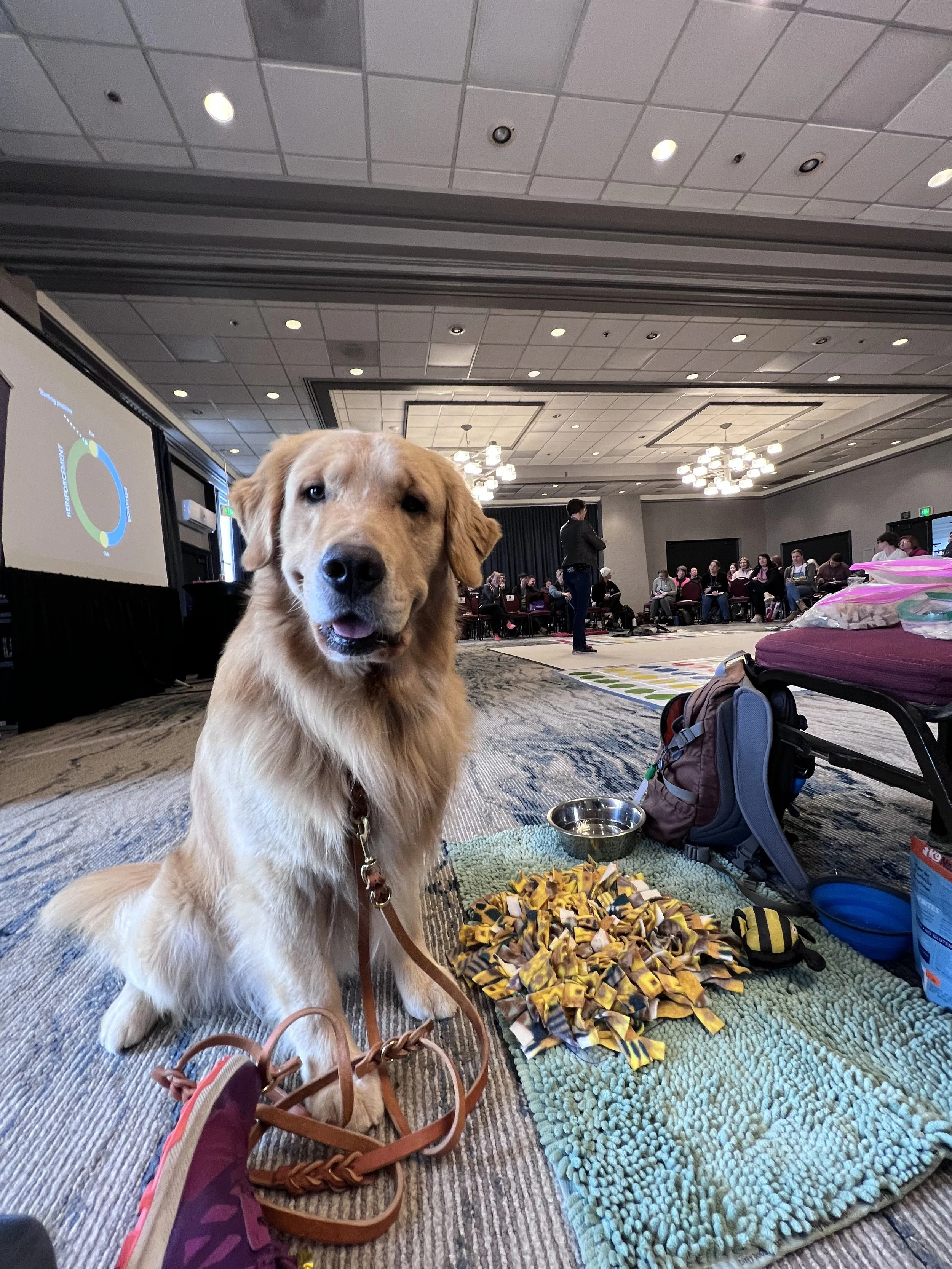
Leo on his pause station at Clicker Expo
Having a spot that signaled him it was pause between exercises helped him understand when he was free to flirt with the crowd and when he was being asked to focus on me.
Regardless of whether you are doing a shaping session or session working on specific cues, you should have a clear way to signal the start and finish to each session to keep that space free of other behaviors. So let’s look at the idea of stations that start and stop our session. By session I do not mean the complete 5-15 minute training period, I mean the session of each behavior practice. So maybe in one training period you work on: sits & downs, recall, a trick or two. Each one of those would be it’s own session. It might also be only 15-30 seconds of the same behavior but in seperate sessions. So 15 seconds of sit, pause, 15 more seconds of sit, pause, etc…
We can use a station to represent the start and stop of a session, this way your dog knows when focus is expected and when they free to explore. This can even mean THEY signal the stop of their ability to focus by offering a return to the pause station. Here is a video demonstrating introducing stations.
So for a training period I might start my dog on their pause station, then bring them to the start station, we do not have to be stuck there, but it would signal the start of focus time. Then when I am done with that set of reps or maybe I feel I am running out of treats, or I feel unclear about whar to do next, I can guide my dog to the pause station as I regroup. Or maybe I am ready to move from working on sits and downs to working on cooperative care, I can release to the pause station and regroup to start working on the next task. This gives my dog clear information for those transitions.
Do I have to be this perfect and picky???
Of course not. You can stick with whatever works for you! However, if you find there are times you are frustrated with your dog because they are “blowing you off”, “being stubborn”, “only want to do it if they see a treat first”, “only do it when they want to”….These more often than not are indications your dog does not truly understand what is being asked of them. They do not understand your cues as well as you assume they do. We can have very high expectations for our dog’s ability to understand us, because they are very good at deciphering our puzzles but quite often their ability to do so is dependent on things we do not realize and when we forget to do those things because we are stressed, we blame them.
If you do nothing else, reinforce that stillness and waiting with you for what’s is next!!! Far too often I see or work with dogs that do a behavior for a split second and then disconnect. They did the come, so leave. They did the sit so immediately race off the second they get the cookie (or even before). Slow down and pay attention to the between moments and your dog will too!
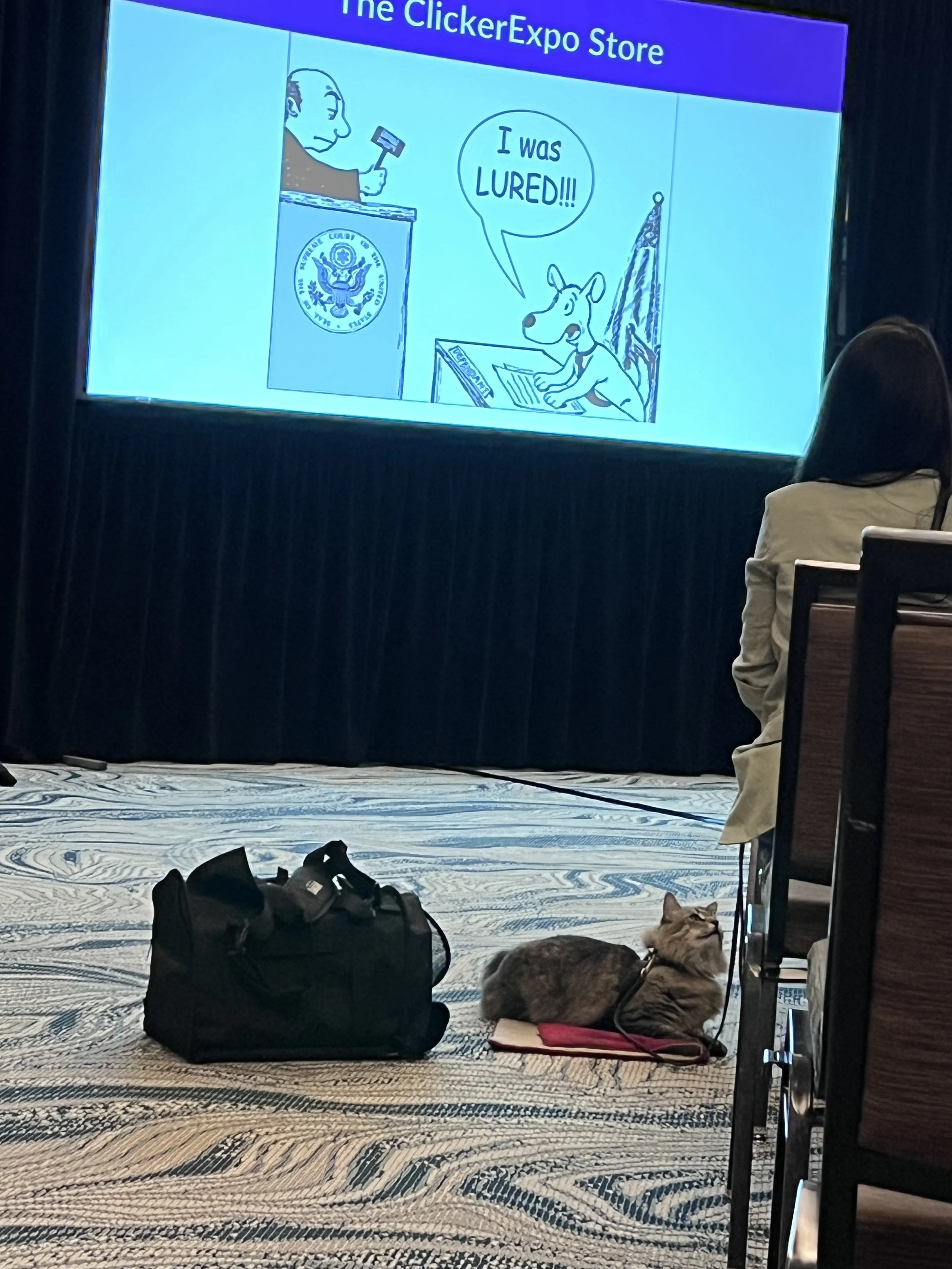
Here is a cat doing a beautiful place in a room with 500 people and a hundred dogs. Presented as an inspiration that when we train and communicate clearly it is amazing what animals can learn! Melissa Millett and Tonic